
Washington Lawyer January/February 2026
By John Murph
Former D.C. Bar president Shirley Ann Higuchi spent two decades caring for her father, Dr. William Higuchi, until he passed away in May 2024 at age 93. At the time she was serving as primary caregiver, Higuchi was also leading the legal advocacy office of the American Psychological Association.
The last few years of that period were particularly grueling. In 2020 Higuchi was visiting her father in Salt Lake City, Utah, for his 89th birthday when the pandemic broke out, making travel back to Washington, D.C., impossible. Her organization’s immediate shift to full-time telecommuting made it possible to extend her stay to half a year. It was a mixed blessing of some sort, Higuchi says. “My father said, ‘I think I’m the only person I know that benefited from COVID because I have you here.’”
As her father’s dementia worsened, Higuchi decided to hire professional help for 24-hour care. During this time, Higuchi was also working with the Heart Mountain Wyoming Foundation, which preserves and memorializes the Heart Mountain World War II Japanese American internment camp. Her contacts at the association helped her find assistance.
“When my father needed a full-time caregiver, I found this fabulous woman and her sister and niece to help,” says Higuchi, who currently serves as the foundation’s chair and president of the Bar Association of the District of Columbia.
The ‘Sandwich Generation’
According to a 2023 Guardian Life Insurance report, Standing Up and Stepping In: A Modern Look at Caregivers in the U.S., the number of people caregiving for a child, parent, or other relative in the United States has increased from 43.5 million adults in 2015 to 53 million in 2023.
“Typically, caregiving needs have been picked up by a demographic that’s been termed the ‘sandwich generation’ — workers between the ages of 35 [and] 64 who are responsible for caring for both children and aging parents,” the report states. But now millennials have surpassed Generation X as the largest cohort of caregivers who also work full-time, according to the report.
A 2019 Harvard Business School report noted that 73 percent of employees surveyed across various sectors, including law firms, have taken on caregiving responsibilities in some capacity. With the growing elderly demographic, the Guardian Life report suggests that “the number of full-time working caregivers is projected to grow.”
Higuchi describes her father, who was chair of the University of Utah’s pharmaceutics department, as a “workaholic” whose contacts were mostly professional. “He had lost contact with people who might have stepped in to help him because all of them were work-related,” Higuchi says. “And typically, in those situations, [former colleagues] don’t feel a responsibility. He didn’t have a very close community that he could lean on. Also, Japanese American men like my father are pretty reserved; he wasn’t a big socializer.”
Being a second-generation Japanese American also shaped Higuchi’s father’s views on aging and how he wanted to live his remaining years. He was unwilling to go to a nursing home or assisted living facility. Even though Higuchi has two brothers, who lived closer to their father, most of the caregiving responsibilities fell on her shoulders.
Higuchi says she “got very resentful and angry” at her siblings, although one of them became very supportive during the last two years of their father’s life. “But the reality is that … the responsibility was primarily mine,” she says.
This is not uncommon. According to AARP and the National Alliance for Caregiving, approximately 60 percent of Americans who care for loved ones while working full-time are women.
The Juggling Act
Higuchi had been down this road before. She also cared for her mother, Setsuko, after she was diagnosed with pancreatic cancer.
Setsuko relocated to Washington, D.C., for treatment at Johns Hopkins Hospital in Baltimore, before passing away in 2005. “My mom was my cheerleader,” Higuchi says. “When I was running for D.C. Bar president, she helped me with a campaign party. She was with my dad at my D.C. Bar [swearing-in] dinner; she loved every minute of it.”
“The great thing about my mom coming here was that I had support,” Higuchi says. “I had friends, and I had my son here; he was able to help out and drive around.” A flexible work schedule also allowed her to periodically work from home or adjust her start time as needed.
Higuchi says the situation reinforced her belief in the importance of being transparent with colleagues about personal challenges. When Higuchi spoke with Bar leaders about her mother, they vowed to support her so she could “step away” when necessary rather than resign.
In Utah, while caring for her father, Higuchi says remote work with the American Psychological Association gave her some time to engage in self-care. Her primary strategy was to gain control over the scheduling process. “I would set meetings early in the day or try to push essential calls toward the late afternoon to avoid conflicts with doctor appointments in Utah,” she says.
“To maximize efficiency and predictability for my team and myself, I adopted a policy of scheduling conference calls in 30-minute increments, or no more than one hour each, back to back,” Higuchi adds. “This allowed me to complete five to six calls within a four-hour window. I also tried to batch meetings for mornings on Tuesdays, Wednesdays, and Thursdays, leaving Mondays and Fridays flexible for emergencies.”
Working around psychologists was also helpful, Higuchi says, as they understood the challenges that come with caregiving.
Life, Rearranged
Patent attorney John Harrity had a similar caregiving journey with his mother, Virginia. He relocated her from North Carolina to his home in Centreville, Virginia, in September 2020 after she was rediagnosed with aggressive lymphatic cancer. She died in December of that year.
“My dad was incapable of taking care of her,” Harrity says. “So, my brother and I convinced her to move up here with me and my wife, Eileen. This was the first time I had been around someone who had a terminal illness. We knew that she was going to die.”
Harrity says that caregiving was “a tough balancing act.” Like Higuchi, he took advantage of remote work during the pandemic. As a partner at Harrity & Harrity LLP, he delegated some of his work when needed. He converted his home office into his mother’s bedroom, and then moved his workspace right next to it. “My wife did most of the heavy lifting during the day while I worked,” Harrity says.
“As my mother’s health deteriorated, we put a camera in her room with a motion sensor, and my phone would get an alert if she moved out of that bed,” Harrity recalls. “If my mother was not in that bed, I would race down the stairs because I was just afraid because she had some memory issues. There were a lot of sleepless nights. It got to a point where we had to hire an aide to sit with her overnight.” As his mother’s cancer progressed, Harrity decided to hire hospice nurses to assist.
Harrity acknowledges that being a founding partner at his firm gave him the flexibility he needed during those years, in addition to the caregiving support from his identical twin brother, Paul.
“It probably would have been different if I was an associate at a law firm where I had a billing requirement,” Harrity says. “If I were, I would hope that the law firm would accommodate me in a situation where I would be taking care of my mother at her end of life. But at my firm, we have such a great environment. When you hire correctly, you can hand off critical things with full confidence if you’re going through something like caregiving.”
“If I was not able to work remotely, it would have been exponentially worse,” Harrity adds.
An avid runner and basketball player, Harrity used physical exercise as self-care. “I usually get up around 5 a.m. and get in my exercise on a daily basis before [my wife] wakes up,” he says. “But when my mother was living with us, I wasn’t sleeping as well. So, I had to push that exercise into the daytime while my wife was able to watch her. Detox, for me, is exercising.”
Running on Empty
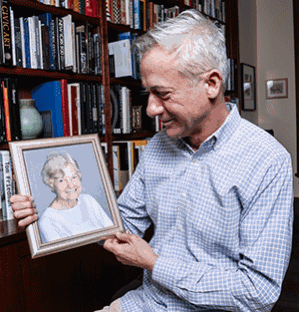 Exercising also became a primary wellness tool for Lars Etzkorn, a solo estate planning attorney, when he cared for his mother, Hildegard, for five years as her dementia worsened and as she battled breast cancer for the fifth time.
Etzkorn recognized early signs of dementia in his mom — behavioral changes with money as well as decreasing reading habits — around 2015 when he was visiting her in St. Louis. “I had a very close relationship with my mother,” Etzkorn says. “Instead of visiting her maybe three times a year, it became four times, then five times, then six times a year. Ultimately, it was about every two weeks. It [had an effect on] my work, but it was manageable because it was usually one day away from work.”
When his mother could no longer live independently in St. Louis, Etzkorn moved her to Washington, D.C., to stay with him and his husband, Gregory. “Initially, I ... naively thought her coming to our house was going to be the best place.” About 13 months later, Etzkorn says
he had to make a difficult decision. His mother agreed to move into a senior living community in the District for a year until she needed a full-service facility for memory care. She passed away in 2022.
“I have an incredibly supportive spouse who welcomed my mother as part of our household,” Etzkorn says. “But when she lived with us, I was interacting with her every hour while also doing business from my house and juggling my relationship with my husband. There were a lot of times when I just wanted to scream. I needed to find a way to release, whether that was actually physically screaming or going to the gym.”
Being a solo practitioner provided Etzkorn with more elasticity in terms of how much he was willing to take on. “I didn’t have to report to a senior partner,” he says.
“During that time, I certainly knew that I needed to take care of myself, to do something that brought me a little piece of enjoyment,” Etzkorn adds. “I also knew that I was becoming a better lawyer as a consequence of this endeavor. When I have clients who are either going down the path of dementia, or going to be caregivers for loved ones, I can serve them more effectively, having gone through that experience myself.”
Support for Lawyers
Reflecting on her caregiving experiences, Higuchi shares some optimism about the legal profession’s shift toward better work–life balance. “Socializing the importance of being flexible and supporting employees is important,” she says. “It also helps to have resources in the human resources department that allow for completing your work while telecommuting. I think most law firms really don’t care where you bill the hours; they just want to make sure you’re billing the hours.”
Harrity would love to see law firms step up and provide something similar to maternity or paternity leave to accommodate lawyers who are also caregivers. “It’s not necessarily that we always need to take off full-time, but to accept a significantly reduced schedule if needed and to provide other accommodations, including monetary funds to help attorneys during these difficult times,” he says.
A January 2022 Rosalynn Carter Institute for Caregivers report, Invisible Overtime: What Employers Need to Know About Caregivers, stated that caregiving employees typically provide more than 20 unpaid hours per week offering assistance. So, if a lawyer is practicing solo, that cuts down on the waking hours available for work, even if there is flexibility. Additionally, caregiving could have some serious negative consequences for attorneys working at law firms that focus highly on billable hours.
The District of Columbia’s Universal Paid Leave Amendment Act provides individuals working for private employers up to 12 work weeks of qualifying family leave to care for a sick family member with a serious health condition.
Lawyers dealing with caregiver stress, especially in today’s economic and employment environment, can also reach out to the D.C Bar Lawyer Assistance Program (LAP) for support. “If a member comes to us and says, ‘I’m stressed because I’m in a caregiving position,’ our programs could be helpful in terms of one-on-one counseling or referrals to other support groups,” says LAP Associate Director Denise Perme.
“Depending on the situation, the LAP counselor could work with them to develop a plan for lowering their stress level or another plan for accessing outside resources to help them in their caregiver role,” Perme adds.
Amy Goyer, family and caregiving expert at AARP, recommends that caregivers pay attention to changes in their own physical, emotional, and mental health. “Be aware of your own red flags,” Goyer says. “For example, if you anger more easily, find yourself arguing more with your spouse, becoming more irritable at work, or not taking care of your personal hygiene like you normally do, seek help.”
“For many caregivers, the deeper they fall into the abyss, the more they actually resist help,” says Goyer. “They don’t ask for help, and then when it is offered, they say, ‘I am okay; I am doing all right,’ when they’re really not. And that’s partially because they are so overwhelmed they cannot even think how to ask for help.”
That’s when an intuitive colleague can step in. The National Institute on Aging suggests listening, being an emotional support, and offering to take on a specific task to relieve a caregiver’s burden.
Reach D.C. Bar staff writer John Murph at [email protected].
