
Washington Lawyer July/August 2026
By Jeremy Conrad and John Murph
Each year, in rooms buzzing with questions and curiosity, the nation's founding ideals come alive for D.C. youth — not as distant history but as living conversations. Constitution in the Classroom, a partnership between the D.C. Bar and American Constitution Society, helps students trace the United States' experiment with democracy from bold declaration to enduring framework.
For the volunteers who give their time for these lessons, the experience is as meaningful as it is instructive. To them, the U.S. Constitution is not just a legal document but a shared responsibility — one that depends on each generation understanding and engaging with it. This year's program on April 1 reflected on the ideals of liberty and equality promised in the Declaration of Independence in 1776 and enshrined in the Constitution 11 years later.
Constitution in the Classroom at the D.C. Bar was first proposed by Patrick McGlone during his term as president (2017–2018). Since then, the D.C. Bar has been hosting students from the District's elementary, middle, and high schools at its headquarters every year for a day of civic education led by attorneys and law students.
McGlone, senior vice president, general counsel, and chief compliance officer at Ullico, continues to be a visible presence at these classes to "see [the teaching] in action." At this year's Constitution in the Classroom program, McGlone spoke with the students about the significance of the birthright citizenship case argued before the U.S. Supreme Court in April. Born in the United States to parents of Irish citizenship and residency, McGlone said he would not have been granted U.S. citizenship without the 14th Amendment.
"I think it's critical for students at a young age to understand that there is a Constitution, that there are certain rights guaranteed by the Bill of Rights, and that that foundation goes back over 200 years," McGlone says. "The Constitution has been changed from time to time, but there are certain bedrock principles behind it. So, as students see popular or current developments, they know that there's a constitutional framework to our civic engagement. One of the benefits of these programs is to remind them that our current government is not writing on a clean slate."
McGlone says his favorite moment during Constitution in the Classroom is seeing the curiosity of students about how the government works and hearing their smart questions. "The ones who are at the middle school and high school levels often have had enough exposure to the law in one way or the other," he says. "I'm often impressed by just how attuned they are to real issues, either concerning the Constitution or other laws."
"It's rewarding for me to know that the concept I [developed] some years ago is paying some dividends," he continues. "The students are walking out having learned something that they didn't know when they came in. That's very edifying."
With more than a dozen attorneys and law students turning up this year to volunteer to teach the Constitution to nearly 200 students, McGlone is not alone in feeling the rewards of bringing the founding document to life in the minds of today's youth.
Sparking Curiosity in the Law
At the 2026 Constitution in the Classroom event, U.S. Department of Justice attorney Sam Bean and U.S. Department of Homeland Security contract compliance investigator Kelechi Eke taught a class of seventh graders from DC Prep Benning Middle Campus.
"I loved civics and the Constitution when I was in school, so the opportunity to come teach kids those topics is really exciting for me," Bean says. "It also is a great way for public service and an opportunity for me to share my professional experience navigating constitutional issues with the kids."
"In the first class I taught, we covered separation of powers, and so I had the kids split up into groups, each of which represented a branch of government. Each group came up with some policies that they wanted to implement and had to convince the other branches, and wield whatever power their branch had, to try and make that happen. I think their government agreed to give everybody free video games," he adds.
"I get a real sense of giving back and fulfillment from working with the kids. And maybe even one of them becomes interested in the issues and becomes an activist or a scholar or even, God forbid, a lawyer.
But at the very least, hopefully it inspires an interest in being informed and participation. Plus, it's fun to hear about what the kids are thinking about," Bean says.
Eke says she was inspired to volunteer because "it is essential that everyone, especially the future leaders of our nation, understands the rights guaranteed to them by the Constitution."
"My goal is to make learning about the law engaging, fun, and accessible, while empowering students with a clear understanding of their rights," Eke adds. "Through this experience, I hope to spark curiosity about the law and encourage students to view the Constitution as a living document that continues to shape their daily lives."
Light Bulb Moments
Administrative Law Judge Christopher Costa of the D.C. Office of Administrative Hearings has been volunteering with Constitution in the Classroom for more than five years. "I love teaching about [the] American government and about the Constitution because they affect everyone's lives," he says. "The thing about our American Constitution compared to other constitutions I've seen in the world is that ours is very much a part of our pop culture. It relates to our everyday lives."
From his many years volunteering with the program, Costa says that his fondest memories are the aha moments during class. "It's like watching a light bulb turn on inside their heads after they learn something new about the U.S. government," Costa says. "That's an exciting moment, especially when they dive into the 14th Amendment."
"It's meaning[ful] for me to talk about concepts regarding the U.S. Constitution with other people," Costa adds. "When you teach someone who feels like they're powerless and doesn't have a voice because they don't understand how the government works or the complexities of a law, I can help make things understandable."
Roomful of 'Little Lawyers'
Aimee Saginaw, an attorney in private practice, began volunteering for Constitution in the Classroom in 2017. Prior to arriving in the District and practicing law, she taught young kids. "I love going into schools, so it was only natural that I continued when I moved to D.C.," she says. "As a former teacher, I love working with students, particularly teaching law. No matter what their age, students intuitively grasp notions of right and wrong and fairness. It's always insightful — and often amusing — to hear their takes on legal issues."
"The best moments are when kids light up when I tell them what great answers they've given," she adds. "I also love watching them transform into little lawyers when I call them 'counselor' during mock oral arguments, or into judges when I give them the toy gavel I always bring with me. Listening to them proclaim 'order in the court' while banging the gavel is usually a highlight."
Saginaw says that she benefits from the energy she gets from interacting with the kids attending Constitution in the Classroom. "I love hearing their perspectives on legal issues and the arguments they come up with during our mock trials," she says. "And the hugs they give me at the end of the sessions are also great."
Learning Using Hypotheticals
While in law school years ago, Karla McKanders says one of the most rewarding things she did was take part in street law at a school in Durham, North Carolina. "It was fun to engage with young students who are just learning about civics and to ideate with them on possibilities of what our multi-racial democracy could be," says McKanders, director of the Thurgood Marshall Institute at NAACP Legal Defense and Educational Fund.
At this year's Constitution in the Classroom, McKanders and other volunteers engaged the students using hypotheticals around the Constitution. "We all gathered around in a circle on the floor and had the students in groups apply the Constitution — the 14th Amendment — to the hypotheticals. It was interesting and heartening to see the students get excited about the different scenarios and discuss the potential ways in which the law could be applied," she says.
McKanders says the program is invaluable for attorneys to engage with young people. "The students' dialogue added perspective to how young people see the law and apply it to their everyday life," she says. "Constitution in the Classroom is an essential program for the Bar, attorneys, and students. I thought about my early experience as a kid and how interactions with lawyers helped me to make the decision at a very young age that I wanted to become a lawyer."
 'This is the Point'
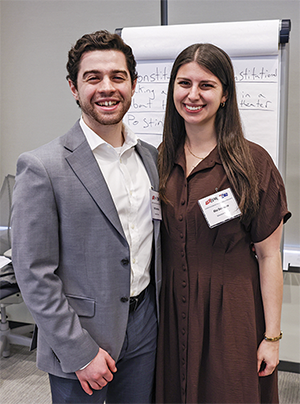
Georgetown University Law Center students Gia Scirrotto and Will Hamilton, along with Lourdes Victoria Venes, led a classroom of third graders from J.C. Nalle Elementary School.
"My friend Will told me about Constitution in the Classroom, and I'm involved in the American Constitution Society on our campus, and I like what they do and support their mission," says Scirrotto. "I was excited about the idea of working with the D.C. community because at Georgetown Law we are a little siloed … I thought it would be nice to engage with kids who live here."
Teaching a big class of third graders was an "energetic experience," Scirrotto says. "We had them up and running across the classroom. I wanted to make sure that they actually learned something. When we asked what they had learned, they said they learned about the Constitution, the First Amendment, and the government, so I'm glad they got something out of it and had fun doing it," she says. Scirrotto plans to return next year to volunteer, "and hopefully throughout my career here in D.C."
"It's important, at a young age, to understand what your rights are, especially in this tumultuous time for constitutional law. Instilling these principles at an early age is important because they'll be able to see their value. The First Amendment means a lot, and explaining that to them is exciting. Hopefully they can carry the lessons with them as they grow," she adds.
Hamilton's interest in the law was sparked by his high school English teacher who encouraged debate in his class. "He pulled me aside one day and pitched the idea to me that I could do this for a living and be a lawyer," Hamilton recalls. "I think back on that moment as a turning point for me."
Hamilton sees Constitution in the Classroom as an opportunity to do the same for others — "to introduce the idea to someone at a young age that they could go and do that one day, too."
"I was here last year, and the biggest trick is to keep the kids engaged. Last year we maybe did a little too much talking, so this year we had them get up and move around the classroom and incorporated lots of interactive activities," he says. "The kids really enjoyed putting on the judge's robes and banging the gavel. I had a great time, and I think they had a great time, too."
Hamilton also benefited from the program as a reset. "We're at a time, right now, when we are really caught up with a lot of things … studying for finals and sending out applications. It's a crazy schedule, and we were stressed about getting in," he says. "It was an opportunity to step back and see that this is the point. There is a reason we are in law school, not [just] sleeping and studying. This was a good reality check, and a reminder not to get too caught up in our day-to-day grind."
"I look forward to coming back again next year," he adds.
Photos by Jati Lindsay
