

Issues & Trends
Surge in Law Enforcement Activity in D.C. Highlights Tension Between Congressional Power and Home Rule
December 09, 2025
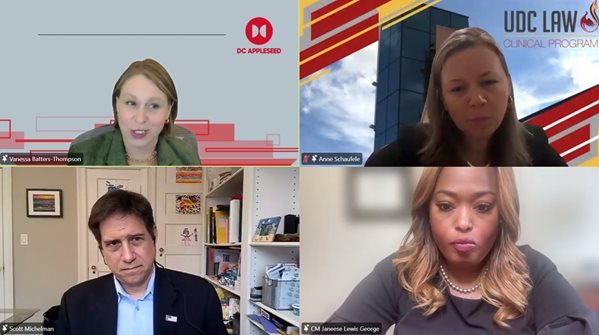
Clockwise from top left: Vanessa Batters-Thompson of DC Appleseed Center for Law and Justice, Anne Schaufele of the UDC David A. Clarke School of Law, D.C. Councilmember Janeese Lewis George, and the ACLU's Scott Michelman.
Back in August, the federal government announced a takeover of law enforcement functions in the District of Columbia, deploying the D.C. National Guard, requisitioning services of the city’s Metropolitan Police Department (MPD), and ramping up the presence of federal agents. For the D.C. legal community, discussions about government overreach lead back to the Home Rule Act.
This fall the D.C. Bar’s District of Columbia Affairs Community held a virtual program on the relationship between Home Rule and the federal government’s recent surge in immigration enforcement activities. Moderating the event, DC Appleseed Center for Law and Justice Executive Director Vanessa Batters-Thompson began by reiterating the restrictions limiting the District’s voice in setting policy.
“D.C. is not a state,” said Batters-Thompson. “D.C. is a federal district, as laid out by the ‘district clause’ of the Constitution, which grants Congress the power to exercise exclusive jurisdiction over D.C.”
Batters-Thompson then described the 1973 passage of the Home Rule Act, which gave the District some autonomy but allowed Congress to retain the right to overrule D.C. laws and exercise budget oversight. In addition, Congress is responsible for confirming local judges, and the president appoints the U.S. attorney for the District of Columbia.
Batters-Thompson also noted the intertwined nature of policing in the District, saying that the MPD, while locally funded and run, has cooperative agreements with more than 30 federal law enforcement agencies. Sentenced felons in the District are also transferred to the Federal Bureau of Prisons.
Batters-Thompson described the current moment as one of unusually intense federal intervention into local affairs, not only through heightened law enforcement but also through numerous congressional bills impinging on the District’s rights. One bill, for example, would eliminate the Judicial Nomination Commission, which screens, selects, and recommends to the president candidates to be judges on the D.C. Courts.
Ward 4 Councilmember Janeese Lewis George elaborated on congressional action taken last spring that would have caused a $1.1 billion budget gap in the District. “In 2025 the federal funding bill created a budget hole for D.C. by stripping the provision that allowed the city to spend its own locally generated tax revenue,” she said. “This effectively reverted the city back to its 2024 budget levels.” The city had to enact some cuts, but it avoided the most damaging ones by taking advantage of budget powers not regulated by Congress.
That congressional action was followed by the federalization of the MPD, resulting in what Lewis George characterized as the deputization of local police for use in immigration enforcement activities.
As councilmember of a ward with a high immigrant population, Lewis George said that she had a firsthand perspective on the activities of U.S. Immigration and Customs Enforcement (ICE), Department of Homeland Security, and MPD officers. “They are exercising stops and detaining and taking away immigrant community members,” she said. “This is happening pretty much on a daily basis in my particular part of the city.”
Lewis George has been collecting detailed information regarding these actions and providing on-the-ground triage to assist those who are being detained and held. “The Council has actually had to hire … a lobbying firm to lobby Congress for us,” she said.
Scott Michelman, legal director of the ACLU of the District of Columbia, cited several lawsuits brought by his organization that allege violations of the Constitution or federal law in the federal government’s commandeering of the MPD, its use of the National Guard, and its immigration enforcement activities.
“We’ve sued to stop ICE’s warrantless arrests,” Michelman said. “It’s unlawful, and it is contrary … to the values we hold as Washingtonians in terms of inclusiveness, due process, and respect for the law and our fellow community members.”
Additional lawsuits relate to the right to protest. Michelman described one suit in which their client, Sam O’Hara, followed National Guard members on patrol while playing the Star Wars “Imperial March” theme. Guardsmen called MPD to detain O’Hara, resulting in the ACLU suit against the National Guard and MPD officers involved for alleged infringements on O’Hara’s First Amendment rights.
Anne Schaufele, assistant professor of law at the University of the District of Columbia David A. Clarke School of Law and co-director of the school’s Immigration & Human Rights Clinic, said that recent events have caused her to reconsider every aspect of her work. “Is it safe for our client to meet with us in person on a law school campus in the District of Columbia?” she wondered. “Will our client be detained on their way to work, on their way to school, at a court hearing? How do we communicate with our clients?”
Schaufele described a recent case pending in the U.S. District Court for the District of Massachusetts in which an immigration attorney had his phone containing client contacts seized after a vacation abroad; his suit is asking the Trump administration to destroy the data it took from the device.
Schaufele noted that this is not the only threat immigration attorneys currently face. “We might face an ethics complaint or a lawsuit as a result of the March 2025 directive,” she said, referring to a Trump memorandum targeting lawyers and law firms for alleged ethical misconduct.
Michelman elaborated on concerns regarding retribution against those who serve immigration clients. He said that executive orders and federal actions targeting law firms and legal institutions have damaged his ability to rally pro bono support. Although he has been able to staff cases, there have been delays, and some firms have only been willing to help behind the scenes rather than publicly represent a cause as they might have in the past.
Lewis George agreed. “We rely on pro bono and legal partnerships to keep the system functioning here in D.C., and that’s why we fought really hard this Council period to restore funding to the Access to Justice Initiative, and that is why access to justice funding was so critical and remains so critical,” she said. “Pro bono and legal aid partnerships protect our most vulnerable residents, so chilling that work harms the very people who need the most protection.”
Batters-Thompson noted the breadth of impact on legal services providers. “These are not just attacks on fancy law firm partners. They are attacks on our ability to staff D.C. Superior Court, the Landlord Tenant Resource Center, and the Probate Self-Help Center. So many functions in D.C. related to access to justice … are incredibly reliant on pro bono, so this has severe downstream consequences for our communities living on low incomes.”
When asked about how to respond to the pressures faced by the District and its residents, panelists generally agreed that continued education and advocacy relating to District statehood and autonomy were necessary, both here and around the country, since D.C. is reliant upon national political opinion in its quest for equal representation and autonomy. Supporting pro bono efforts is also a vital response to the pressures faced by immigrants, tenants, and others.
“Silence is complicity,” Lewis George said. “D.C. belongs to its residents, not to Congress, not to ICE, and not to the Trump administration. Your ability to stand up right now and fight is critical and important, so please find the avenue or the energy that best suits you and plug in.”
