D.C. Court of Appeals Debuts Virtual Tour
May 19, 2026
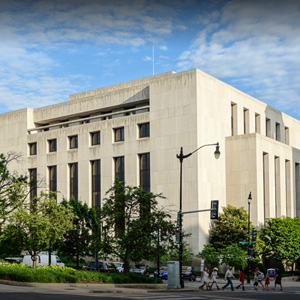
The D.C. Court of Appeals has launched a virtual interactive platform that allows users to take an immersive, 360-degree tour of the courthouse, explore the court's history, and familiarize themselves with the court's judges and staff. Released on May 11, the new website follows the launch of D.C. Superior Court's own interactive site in late 2024. Both websites were created by the tech company YOUTOPIAN.
D.C. Court of Appeals Chief Judge Anna Blackburne-Rigsby said the virtual tour is helpful not only to parties entering the court but also to lawyers, educators, and the general public. "We want people to understand [the court] a little better and to be able to engage with our court and its rich history," she said.
When D.C. Superior Court launched its interactive site, Judge Blackburne-Rigsby knew right away that the Court of Appeals needed one as well. "I thought we needed a tool like [theirs], perhaps even more [so], because I think a lot of people have some sense of what happens in a trial court," Blackburne-Rigsby said. "There are all kinds of shows and movies about what happens in a trial court. The appellate process is a lot more mysterious, a lot less understood. A tool like this can bring people to the courthouse in a way that engages them. They can see, step by step, how the process works."
Most people think the appellate process mirrors trial court procedures, which often include a jury and witnesses, the chief judge said. "One of the differences is that we are not starting from scratch," she explained. "We're reviewing what happened at the trial court, and we're trying to decide if there was a legal problem with what happened or procedural unfairness. Even if we disagree with what may have happened in trial, that doesn't mean it was wrong or that it should be reversed. So, there have to be specific legal reasons. Another key difference [is that] instead of one judge, there's a panel of judges."
"[Also], the case not only resolves the party's issue before us; it becomes what we call 'precedent,' or the law of the District of Columbia that is binding," Blackburne-Rigsby continued. "Whereas in Superior Court, when a case is decided it's a decision just for that case."
When visitors take the virtual tour of the D.C. Court of Appeals, they get a chance to "meet" the judges and hear about their professional experiences and inspiration. Throughout the tour, visitors can also learn about the life cycle of an appeal, steps in filing an appeal, and legal vocabulary as well as review prior oral arguments.
The site also offers a glimpse into the court's history, from 1820 to the present. "You can click on the picture of some of the earliest chief judges," Blackburne-Rigsby said. "You can learn that one of the conspirators in the assassination of President Lincoln was tried in this courthouse. There's a display about Frederick Douglass, the noted abolitionist who was the first African American [appointed] as United States marshal. His office was in this building."
The interactive tour is available in English, Spanish, Amharic, and American Sign Language. Visitors have the option to use close captioning, text to speech, and a tutorial menu.
The platform was funded through support of the State Justice Institute, a bipartisan organization that awards grants to improve the quality of justice in state courts and fosters innovative, efficient solutions to common issues faced by all courts.
"[At the D.C. Courts], we talk about outreach; we talk about engaging with the community and telling the story of the court[s]," Blackburne-Rigsby said. "This [virtual tour website] is one of the best tools I've seen to do that."